Building the Modern Dental Tech Stack: Keep, Replace, Consolidate (2026)
A complete map of a modern dental practice's technology - imaging, lab, e-Rx, clearinghouse, payments - with honest keep, replace, or consolidate verdicts for 2026.
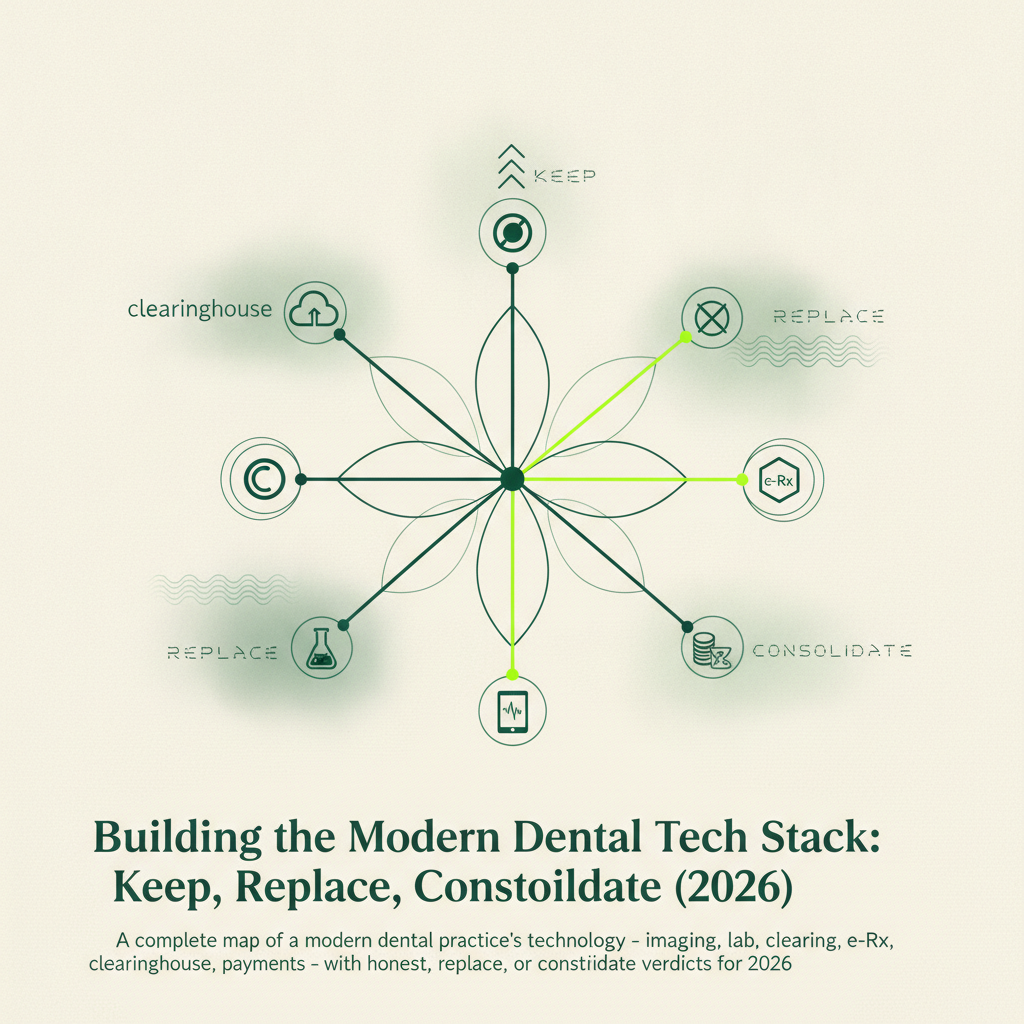
A modern dental practice's technology isn't one system — it's a stack of eight distinct pieces, some of which should stay exactly as they are, some of which should be replaced, and some of which should be consolidated into a broader platform. Treating "what software should I use" as a single question misses that the honest answer is different for each piece. This is the complete map, with a verdict for each layer.
Key takeaways
- A modern dental practice's technology stack has roughly eight distinct layers, each with its own evaluation criteria.
- Imaging hardware and its native capture software are usually a "keep" — imaging AI can layer on top without replacing the capture layer.
- The practice-management system is the layer most worth evaluating architecturally, because everything else depends on or connects through it.
- Point tools around a core system are prime consolidation candidates once their combined cost and integration overhead exceeds a platform's.
- The clearinghouse layer for insurance transactions is largely commoditized and rarely worth agonizing over on its own.
- The right decision for each layer depends on your specific pain points there, not a single practice-wide instinct.
Contents
- Why "what software should I use" is the wrong single question
- The eight layers
- Layer 1: Practice-management system
- Layer 2: Imaging hardware and capture software
- Layer 3: Imaging AI
- Layer 4: Clearinghouse and insurance transactions
- Layer 5: Patient communications
- Layer 6: Payments
- Layer 7: e-Prescribing
- Layer 8: Lab management
- Putting the map together
- How Omnira fits into this map
- Frequently asked questions
- The bottom line
Why "what software should I use" is the wrong single question
Dental technology conversations tend to collapse into a single comparison — this practice-management system versus that one — when the actual technology footprint spans far more ground. Imaging hardware, imaging AI, insurance transaction infrastructure, communications, payments, prescribing, and lab management are all separate layers, each with its own vendors and its own honest keep, replace, or consolidate answer.
The eight layers
Scheduling and records, imaging capture, imaging intelligence, insurance transactions, patient communications, payments, prescribing, and lab coordination.
Layer 1: Practice-management system
The layer everything else ultimately depends on. Worth the deepest architectural scrutiny, because its design — module-based versus shared-data-layer — shapes what's possible in every other layer's integration. Covered in why legacy dental software fails.
Verdict: evaluate this layer specifically and architecturally.
Layer 2: Imaging hardware and capture software
Sensors, panoramic and CBCT units, and native capture software. Usually a genuine hardware investment with a real depreciation timeline.
Verdict: keep, in most cases, unless the hardware itself is due for replacement. Software layered on top generally doesn't require replacing the capture layer underneath.
Layer 3: Imaging AI
A distinct, optional layer from the capture hardware, covered in where imaging AI fits.
Verdict: evaluate independently, expect it to integrate as advisory input rather than a standalone authority.
Layer 4: Clearinghouse and insurance transactions
The rail moving eligibility checks, claims, and remittances between practice and payers. Largely commoditized at this point.
Verdict: rarely worth agonizing over in isolation — more relevant as a checkbox than an independent vendor decision.
Layer 5: Patient communications
Reminders, recall, two-way texting, review requests. Frequently where point-tool sprawl accumulates most visibly.
Verdict: the clearest consolidation candidate in the stack, because communications benefits enormously from sharing data with scheduling and billing in a way a standalone tool can't replicate.
Layer 6: Payments
Ideally hosted and tokenized, keeping card data away from the practice's own infrastructure entirely.
Verdict: keep whatever reputable, PCI-compliant processor you're using unless integration with billing specifically is the problem.
Layer 7: e-Prescribing
A build-versus-buy decision that should always land on buy — certified infrastructure for controlled substances is a heavily regulated category.
Verdict: keep or choose a certified vendor; expect any practice-management system to integrate with one rather than replace it.
Layer 8: Lab management
Case tracking with the labs fabricating crowns and prosthetics. Directly affects the scheduling gate — a seat appointment booked before the case arrives is a wasted appointment.
Verdict: check whether your practice-management system ties lab status to scheduling gates natively, or whether it's a manual, disconnected process.
Putting the map together
Keep the imaging hardware, evaluate imaging AI independently, treat the clearinghouse as a checkbox, seriously evaluate the practice-management system architecturally, consolidate communications if already evaluating a platform, keep a reputable payment processor, keep a certified e-prescribing vendor, and check whether lab tracking is connected to scheduling.
How Omnira fits into this map
Omnira Dental is an AI-native operating system for dental practices — a single platform where six specialized AI agents run the practice's daily operations under human control: Luna (the orchestrator you talk to), Stella (scheduling and recall), Vera (billing and revenue cycle), Relay (patient communications and voice), Aria (clinical support), and Otto (operations, inventory, and analytics). Instead of bolting AI features onto legacy software, Omnira replaces the practice-management system itself, so the receptionist, the biller, and the chart share one brain and one ledger.
Omnira sits at Layer 1 and natively absorbs Layer 5, because those functions share Omnira's own data layer rather than existing as bolted-on tools. Layers 2, 3, 6, 7, and 8 remain integration points: imaging connects through Aria's bridge as advisory input, payments route through a hosted processor, e-prescribing runs through a certified vendor, and lab case tracking ties directly into Stella's scheduling gates.
Frequently asked questions
What are the main layers of a modern dental practice's technology stack? Roughly eight: the practice-management system, imaging hardware and capture software, imaging AI, the insurance clearinghouse connection, patient communications, payment processing, e-prescribing, and lab case management.
Should a dental practice replace its imaging hardware when switching practice-management systems? Generally no. Most modern practice-management systems connect to existing imaging hardware through a bridge rather than requiring replacement.
Is the insurance clearinghouse connection a major decision for a dental practice? Not usually on its own — this layer is largely commoditized and more relevant as a feature checkbox.
Why is patient communications often the first thing to consolidate into a dental platform? Communications benefits enormously from sharing data with scheduling and billing, which is structurally difficult for a standalone tool connecting through a separate integration.
Should a dental practice build its own e-prescribing capability? No. Certified e-prescribing is a heavily regulated product category that should always be a buy decision.
How do I know if my dental practice's lab tracking is a problem worth fixing? Check whether a seat appointment has ever been booked before the lab case arrived.
The bottom line
A dental practice's technology isn't one decision dressed up as many — it's genuinely many decisions, each with its own honest answer. Map your own stack across these eight layers before evaluating anything.
Want help mapping your own stack across all eight layers? Bring your current vendor list and we'll build the keep-replace-consolidate picture together.