The True Cost of Legacy Dental Software (Full TCO, 2026)
A complete total-cost-of-ownership breakdown for legacy dental software - license, server, IT, bridges, point tools, and the labor line every comparison forgets to count.
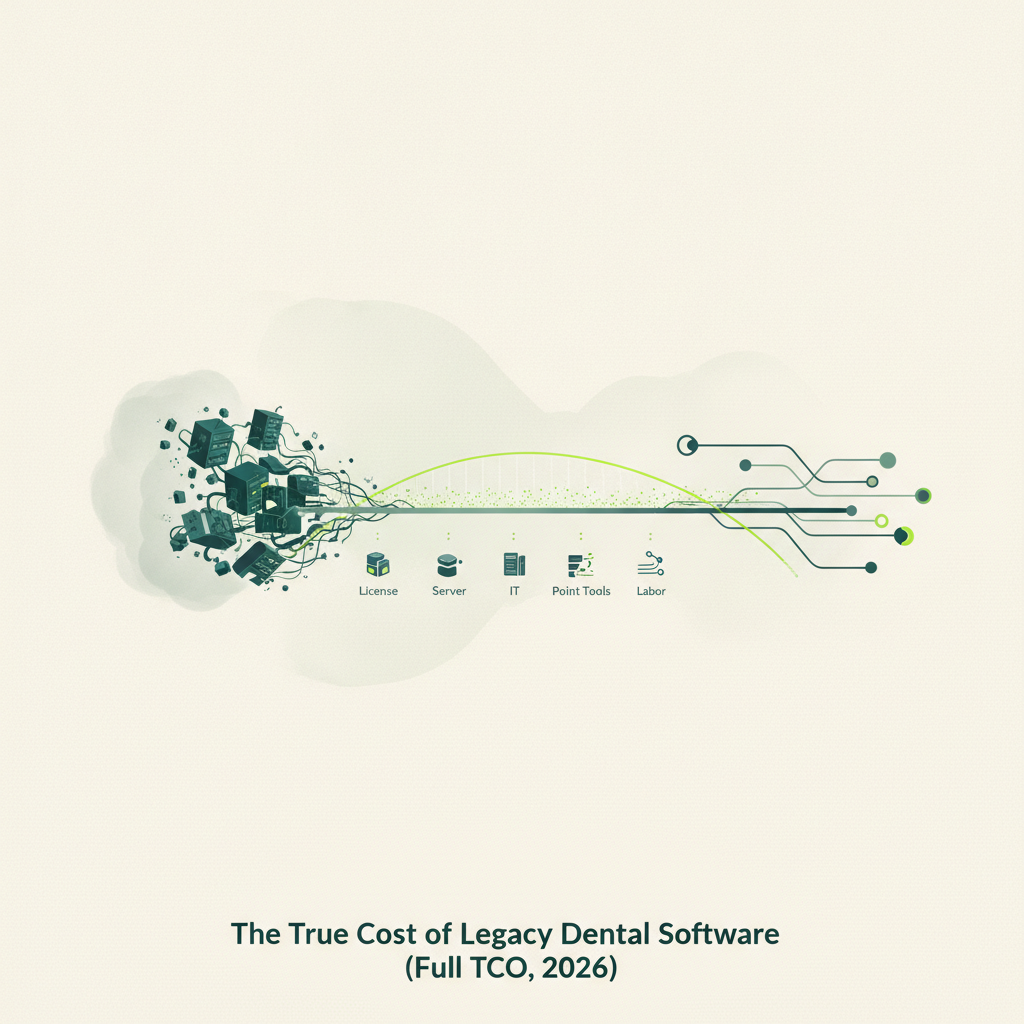
A dental practice comparing its current software cost against a new option almost always compares the wrong number: the license fee against a subscription price, with every other real cost of the legacy system left out. The complete cost of legacy dental software includes the license, the server hardware and its replacement cycle, IT support, the point tools bolted on to fill gaps the core system doesn't cover, the bridges connecting those tools, and — the line that gets forgotten most often — the labor cost of the work the software doesn't do automatically, which someone on staff is doing by hand instead. This is the complete total-cost-of-ownership picture, built to be filled in with your own numbers rather than trusted as a generic estimate.
Key takeaways
- License or subscription fee is usually the smallest, most visible piece of legacy dental software's true total cost.
- Server hardware, replacement cycles, and IT support are real, recurring costs that rarely appear on the same invoice as the software license.
- Point tools added to cover gaps in a legacy system's automation each carry their own subscription cost and their own integration maintenance burden.
- The largest hidden cost in most legacy setups is the labor of work the software doesn't automate.
- A fair TCO comparison has to include this labor line as a real dollar cost, not treat it as a fixed, unavoidable baseline.
- Building your own TCO table, even roughly, is the single most useful preparation for any software evaluation conversation.
Contents
- Why "what does our software cost" is usually answered wrong
- The visible costs
- The costs that hide in a different budget line
- The point-tool tax
- The labor line: the biggest hidden cost
- A complete TCO worksheet
- A worked example
- What to do with this number
- How Omnira changes this math
- Frequently asked questions
- The bottom line
Why "what does our software cost" is usually answered wrong
Ask a practice owner what their practice-management software costs, and the answer is almost always the license or subscription line item. It's also, in most legacy setups, a meaningful understatement of the actual total cost, because the license fee is only the piece that happens to arrive as a single, visible line item. Everything else is real, recurring, and dispersed across other budget lines and payroll that would exist regardless, which makes it easy to mentally exclude from a "software cost" conversation even though it's directly caused by the software's limitations.
The visible costs
License or subscription fee. Per-workstation or per-provider licensing for legacy systems, or a subscription fee for cloud-hosted successors.
Support contract. Often bundled, sometimes separate — ongoing vendor support and update access.
The costs that hide in a different budget line
Server hardware and its replacement cycle. A real, if infrequent, cost that doesn't appear anywhere near the software license invoice.
IT support. Whether in-house or contracted, this appears on an entirely separate invoice — sometimes a fixed retainer, sometimes hourly billing that only shows up when something breaks, easily categorized as "bad luck" rather than a predictable cost.
Backup infrastructure. Local backup hardware, software, and offsite service, separate from the practice-management license.
Downtime. Hard to price precisely, but real: a server failure has a cost in lost production and, in the worst cases, patient trust.
The point-tool tax
Nearly every practice running a legacy core system has added point tools to cover gaps — a communications platform, a posting-automation tool, an AI receptionist, an eligibility-verification service. Each carries its own subscription cost, and each carries an integration maintenance burden, described in why legacy dental software fails.
The point-tool tax compounds two ways: the direct subscription cost of each tool, and the indirect cost of managing several vendor relationships instead of one.
The labor line: the biggest hidden cost
This is the category most cost comparisons skip, and it's very often the largest number in the whole table.
Every task a legacy system doesn't automate is a task someone on staff does by hand — manual insurance verification, manual payment posting, manually working (or not working) denials, manually calling recall patients, manually filling cancelled slots.
The honest way to think about this line: it's not free because the staff member is already on payroll. It's that their time is a finite, valuable resource spent on tasks a better system would automate — an hour spent on manual posting is an hour not spent on case presentation or patient relationships. Valuing this line at fully loaded hourly cost, multiplied by hours actually spent, often produces the largest single line in the entire table.
A complete TCO worksheet
| Category | Annual cost |
|---|---|
| License/subscription fee | $______ |
| Support contract (if separate) | $______ |
| Server hardware (amortized) | $______ |
| IT support | $______ |
| Backup infrastructure | $______ |
| Point tool subscriptions (each) | $______ |
| Manual labor value (hours/week x 52 x loaded hourly cost) | $______ |
| Total | $______ |
A worked example
A hypothetical single-location practice: legacy license $4,800/year, contracted IT support $3,600/year, amortized server replacement $1,000/year, backup infrastructure $600/year, three point tools totaling $6,000/year, and 12 hours/week on manual posting, verification, and recall at $25/hour ($15,600/year).
Total: roughly $31,600/year — against a "software cost" the practice might have named as just the $4,800 license fee.
What to do with this number
Once you have your own complete TCO figure, it becomes the actual, fair basis for comparing against any alternative, rather than comparing a new option's subscription price against your old system's license fee alone — a comparison that structurally favors staying put regardless of whether staying put is actually cheaper. This is the same discipline described in how much dental AI software costs.
How Omnira changes this math
Omnira Dental is an AI-native operating system for dental practices — a single platform where six specialized AI agents run the practice's daily operations under human control: Luna (the orchestrator you talk to), Stella (scheduling and recall), Vera (billing and revenue cycle), Relay (patient communications and voice), Aria (clinical support), and Otto (operations, inventory, and analytics). Instead of bolting AI features onto legacy software, Omnira replaces the practice-management system itself, so the receptionist, the biller, and the chart share one brain and one ledger.
Being cloud-native removes the server hardware, IT support, and backup infrastructure lines from this worksheet entirely. Being a full platform rather than a core system plus point tools consolidates the point-tool tax line into one relationship. And because Vera, Stella, and Relay automate the specific categories of manual work in the labor line — posting, verification, recall, denial resolution — that line shrinks as well, though it doesn't disappear to zero, since genuine judgment calls and patient conversations still benefit from a person's time.
Frequently asked questions
What is the total cost of ownership for legacy dental practice-management software? It includes the license fee, server hardware and replacement cycle, IT support, backup infrastructure, point tools, and the labor cost of manual work the software doesn't automate.
Why do practices underestimate the true cost of their current dental software? Because most real costs appear on separate invoices or as payroll that exists regardless, making it easy to mentally exclude them.
What is the biggest hidden cost in legacy dental software? For most practices, the labor cost of manual work the software doesn't automate, valued at fully loaded hourly cost.
How do I calculate the true cost of my current dental practice-management setup? Build a table including license fees, amortized server hardware, IT support, backup infrastructure, point tool subscriptions, and manual labor hours at fully loaded cost.
Should I include staff labor costs when comparing dental software options? Yes — excluding staff time spent on manual tasks understates the true cost of the current setup.
Is a cloud-hosted or AI-native dental platform actually cheaper once everything is counted? It depends on your numbers, but once server, IT, point-tool, and labor costs are all counted honestly, the gap is often smaller or reversed compared to a license-fee-only comparison.
The bottom line
The license fee on a dental practice-management invoice is real, but it's rarely the actual cost of running that system. The server, the IT relationship, the point tools, and above all the labor of doing by hand what a better system would automate are just as real, just spread across different invoices and a payroll line that feels unrelated to the software conversation until you connect them.
Fill in the worksheet with your own numbers this week, honestly, including the labor line.
Want help building this exact TCO table for your own practice? Bring your current invoices and a rough estimate of manual hours and we'll build the complete picture together.