The Dental Revenue Cycle, End to End (All 19 Steps, 2026)
A complete map of the dental revenue cycle from insurance verification to reconciled payment — all 19 steps, where practices lose money at each one, and which steps AI can own.
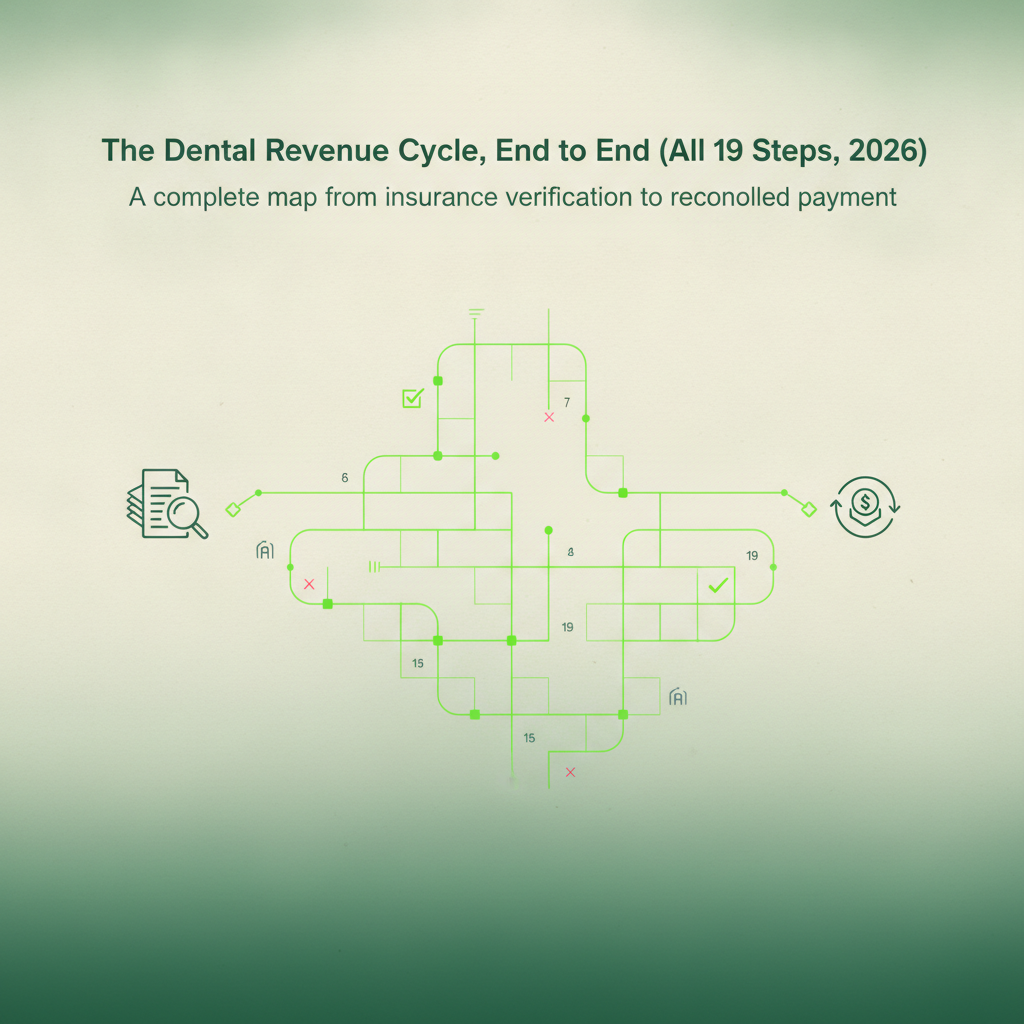
The dental revenue cycle is the complete sequence of events between a patient booking an appointment and the practice holding fully reconciled payment for the treatment provided — nineteen distinct steps spanning verification, estimation, treatment, claim submission, adjudication, denial resolution, patient billing, and reconciliation. Most practices manage pieces of this well and let other pieces run on hope. The pieces that run on hope are almost always invisible until someone adds up the aged receivables and finds a number nobody expected.
This is the complete map, with the leak points named at each step and an honest note on which parts are ready for full automation today versus which still need a person.
Key takeaways
- The revenue cycle has 19 distinct steps, not the 4 or 5 most practices think about (verify, treat, bill, post, done).
- Money leaks at specific, identifiable points — not randomly — and most of those points are well understood and fixable.
- Roughly two-thirds of these steps are rule-governed enough to automate fully today; the rest genuinely need judgment.
- The most commonly skipped step in the entire cycle is working denials past the initial flag — which is also the single largest recoverable dollar amount in most aged receivables.
- Reconciliation — closing the loop between what was billed, what was paid, and what hit the bank — is the step practices trust the most and verify the least.
- A practice that can name all 19 steps and who owns each one has a revenue cycle. A practice that can only name 5 has a series of disconnected tasks.
Contents
- Why "billing" undersells this
- The 19 steps
- Phase 1: before treatment (steps 1–5)
- Phase 2: treatment and claim (steps 6–9)
- Phase 3: adjudication (steps 10–13)
- Phase 4: patient collection (steps 14–16)
- Phase 5: reconciliation and close (steps 17–19)
- Where the money actually leaks
- Which steps are ready for full automation today
- How to audit your own cycle this week
- How Omnira runs the full cycle
- Frequently asked questions
- The bottom line
Why "billing" undersells this
Ask a practice owner what their billing process looks like and you'll usually get four or five steps: verify insurance, treat the patient, submit the claim, post the payment, bill the patient for the rest. That's the visible skeleton. The actual cycle has more than three times that many steps, and the ones missing from the mental model are exactly the ones where money disappears — denial resolution, coordination of benefits, underpayment detection, and reconciliation chief among them.
Calling the whole thing "billing" also creates an organizational blind spot: billing sounds like something that happens after the clinical work, when in reality the cycle starts before the patient is even in the chair and several of its most consequential failure points are upstream of any claim being submitted at all.
The 19 steps
Phase 1 — Before treatment: 1) Eligibility verification 2) Benefits capture 3) Treatment estimate 4) Predetermination (where applicable) 5) Prior authorization (where required)
Phase 2 — Treatment and claim: 6) Clinical documentation 7) Claim compilation 8) Pre-submission validation 9) Claim submission
Phase 3 — Adjudication: 10) Payer processing 11) Remittance receipt 12) Payment posting 13) Denial resolution
Phase 4 — Patient collection: 14) Patient balance calculation 15) Statement and billing 16) Payment collection
Phase 5 — Reconciliation and close: 17) Bank reconciliation 18) Reporting and analysis 19) Month-end close
Phase 1: before treatment (steps 1–5)
1. Eligibility verification. An electronic check confirming the patient's coverage is active as of the date of service. This is the floor, not the ceiling — active coverage alone tells you almost nothing about what will actually get paid.
2. Benefits capture. The deeper layer: annual maximum, how much of it is used, deductible and whether it's met, coverage percentages by category (preventive, basic, major), frequency limitations (how often a given procedure is covered), waiting periods, and clauses like missing-tooth exclusions. Leak point: practices that verify only step 1 and skip step 2 walk into avoidable frequency and eligibility denials that a five-minute check would have caught.
3. Treatment estimate. Built from verified benefits and the practice's actual contracted fee schedule with that payer — not a generic percentage guess. Leak point: estimates built on assumed rather than verified benefits create the surprise-bill conversations that damage trust and slow case acceptance.
4. Predetermination, where the procedure and payer warrant it. A voluntary, non-binding pre-treatment estimate submitted to the payer for larger or less-common procedures — crowns, dentures, implants, periodontal surgery. Leak point: skipped on expensive treatment because it takes time, which means the patient accepts a case on a guess instead of a payer-confirmed number.
5. Prior authorization, where the plan requires it. Distinct from predetermination — this is a coverage requirement, not a courtesy estimate, and treatment proceeding without a required authorization risks an automatic denial regardless of clinical merit. Leak point: the most catastrophic in this phase, because it produces a denial that's fully preventable and often not appealable. The distinction is detailed in predetermination vs. prior authorization.
Phase 2: treatment and claim (steps 6–9)
6. Clinical documentation. The chart entry, notes, and — for many procedures — supporting radiographs or periodontal charting, created at or near the time of treatment. Leak point: thin documentation created after the fact, under time pressure, that won't hold up if the claim is questioned or a documentation denial arrives.
7. Claim compilation. Building the actual claim from the completed procedures — codes, tooth numbers, surfaces, fees, provider information. Leak point: every billed code should trace to a documented, completed procedure; when charting and billing are loosely connected, discrepancies creep in that surface at the worst time, during a payer audit.
8. Pre-submission validation. Checking the claim against known rules before it goes out — missing fields, invalid code-and-tooth combinations, fee-schedule mismatches, missing required documentation for the procedure type. Leak point: this step is where a meaningful share of denials should be prevented and often isn't, because most legacy software validates minimally.
9. Claim submission. Sending the claim electronically. Leak point: submission delay. Claims sitting in a batch queue for days before going out is dead time that pushes the entire cycle later for no reason.
Phase 3: adjudication (steps 10–13)
10. Payer processing. Out of the practice's control, but worth tracking — a claim that hasn't produced any response inside a payer's typical turnaround window is worth a status check rather than passive waiting.
11. Remittance receipt. The electronic remittance advice or paper explanation of benefits arrives, showing what was paid, adjusted, and denied, line by line.
12. Payment posting. Recording what was actually paid against what was billed, applying contractual adjustments correctly. Leak point: manual posting error rates are a well-documented source of quiet revenue loss — mis-posted adjustments, missed underpayments against the actual contracted rate, and coordination-of-benefits amounts applied incorrectly.
13. Denial resolution. Everything not paid gets classified, and correctable items get fixed and resubmitted, documentation gets assembled and sent, disputes get appealed, and everything gets tracked to a deadline. The single largest leak point in the entire cycle. This is the step most often reduced to "flagged in a report" rather than actually worked, and it's where the majority of genuinely recoverable dental revenue sits unclaimed in most practices. Full detail in what a denial engine actually does and the complete denial code playbook.
Phase 4: patient collection (steps 14–16)
14. Patient balance calculation. Once insurance has fully adjudicated (including any denial resolution), the accurate patient-responsibility amount is known. Leak point: billing a patient before insurance has actually finished processing — including any denial still in flight — creates confusing, sometimes incorrect bills that erode trust and generate calls.
15. Statement and billing. Communicating the balance clearly, on a cadence, through channels patients actually respond to. Leak point: infrequent, unclear statements that patients set aside rather than pay.
16. Payment collection. Making it easy to pay — text-to-pay links, payment plans for larger balances, clear breakdowns. Leak point: friction. A balance that requires a phone call during business hours to pay gets paid slower and less often than one with a one-tap link.
Phase 5: reconciliation and close (steps 17–19)
17. Bank reconciliation. Matching what actually landed in the bank account against what the remittances and patient payments said should have landed there. Leak point: the step practices trust most and verify least. Deposits that don't match expected remittance totals, or expected deposits that never arrive, often go uninvestigated for months.
18. Reporting and analysis. Turning the cycle's data into numbers the practice can act on — production, collections, AR aging, denial rates, case acceptance. Leak point: reports nobody reads regularly enough to catch a trend before it becomes a problem.
19. Month-end close. Formally closing the period, confirming all of the above ties out. Leak point: a close that's really just "the software says we're done" rather than an actual reconciled confirmation invites errors to compound month over month, invisibly, until an annual review surfaces a number that doesn't make sense.
Where the money actually leaks
If you can only fix three things, fix these, in order of typical dollar impact:
1. Denial resolution (step 13). This is where the largest recoverable amount usually sits, because it's the step most commonly abandoned partway through. A claim that's been correctly documented and just needs the right resubmission mechanics is close to free money sitting in a queue.
2. Benefits capture and prior authorization (steps 2 and 5). Preventing a denial is always cheaper than recovering one, and both of these steps prevent entire categories of denial before they ever happen.
3. Payment posting accuracy and underpayment detection (step 12). Underpayments against your actual contracted fee schedule are structurally invisible — nothing flags them unless something is specifically comparing every posted line against the contract — and they accumulate quietly for years in practices that have never checked.
Which steps are ready for full automation today
| Step | Automation readiness |
|---|---|
| 1. Eligibility verification | Fully automatable |
| 2. Benefits capture | Fully automatable |
| 3. Treatment estimate | Fully automatable from verified data |
| 4. Predetermination | Largely automatable; submission and tracking, not the clinical decision to treat |
| 5. Prior authorization | Automatable submission and gating; the underlying medical necessity remains a clinical judgment |
| 6. Clinical documentation | Assisted (voice capture, structured templates), not automated — the clinician documents |
| 7. Claim compilation | Fully automatable from completed, documented procedures |
| 8. Pre-submission validation | Fully automatable |
| 9. Claim submission | Fully automatable |
| 10. Payer processing | Not applicable — external |
| 11. Remittance receipt | Fully automatable intake |
| 12. Payment posting | Largely automatable, with exceptions routed to a human |
| 13. Denial resolution | Largely automatable — classification, correction, documentation, resubmission; appeals and true disputes need human approval |
| 14. Patient balance calculation | Fully automatable once adjudication is complete |
| 15. Statement and billing | Fully automatable |
| 16. Payment collection | Fully automatable (the mechanics); financial-hardship conversations need a person |
| 17. Bank reconciliation | Largely automatable, with exceptions flagged |
| 18. Reporting and analysis | Fully automatable data; interpretation benefits from a person who knows the practice |
| 19. Month-end close | Largely automatable, with a human sign-off |
The pattern: roughly two-thirds of the cycle is ready for full automation today, because it's rule-governed and the correcting data typically already exists somewhere in the practice's own systems. The remaining third — clinical documentation itself, medical-necessity judgment, difficult financial conversations, and final sign-off — genuinely benefits from staying human, not because the technology can't attempt it, but because those are the places where judgment, not process, is the actual work.
How to audit your own cycle this week
You don't need new software to run this audit — you need an afternoon and your existing reports.
Pull your insurance AR aging report. Sort by age. For everything over 60 days, ask: is this a denial that was never worked, and if so, why not?
Pick ten recently completed high-value procedures (crowns, implants, perio surgery) and trace each one backward: was benefits fully verified, was a predetermination sent if warranted, was documentation attached to the original claim or only after a denial forced it?
Check five recent remittances against your actual fee schedule, line by line, for the payers you see most often. Underpayments hide in plain sight until someone specifically looks.
Ask whoever handles denials how much time they actually have for it in a typical week, and compare that honestly to how much time the denial queue requires. This conversation alone usually explains most of what the aging report shows.
How Omnira runs the full cycle
Omnira Dental is an AI-native operating system for dental practices — a single platform where six specialized AI agents run the practice's daily operations under human control: Luna (the orchestrator you talk to), Stella (scheduling and recall), Vera (billing and revenue cycle), Relay (patient communications and voice), Aria (clinical support), and Otto (operations, inventory, and analytics). Instead of bolting AI features onto legacy software, Omnira replaces the practice-management system itself, so the receptionist, the biller, and the chart share one brain and one ledger.
Vera owns the full nineteen-step cycle as one connected system rather than nineteen separate tasks assigned to whoever has time:
Before treatment, every appointment gets full benefits capture, not just an active/inactive check, and predetermination and prior authorization are tracked as the distinct instruments they are — with prior-auth-required procedures hard-gated from claim submission until an approval is on file.
Claims compile directly from Aria's documented, completed procedures, so every billed code traces to a chart entry by construction, and pre-submission validation catches the errors that cause front-end rejections before they cost a cycle.
Denial resolution — the step most practices abandon — runs to completion. Denials are classified deterministically, corrected from system-of-record data, documented with exactly what the payer requires, resubmitted as proper replacement claims, appealed with human approval where a dispute is worth fighting, and escalated on a deadline clock through electronic checks, payer portals, and outbound AI calls.
Patient billing waits for real adjudication, including denial resolution, so statements reflect accurate balances rather than provisional guesses.
Reconciliation closes the loop with a three-way match between remittances, postings, and the bank feed, surfacing exceptions rather than assuming everything tied out.
Because all nineteen steps run on one ledger, the reporting in step 18 isn't a separate exercise — it's a live view of the same data every other step already touched, which is what makes month-end close a confirmation rather than a scramble.
Frequently asked questions
What are the steps in the dental revenue cycle? Nineteen steps across five phases: pre-treatment (eligibility verification, benefits capture, treatment estimate, predetermination, prior authorization), treatment and claim (documentation, compilation, validation, submission), adjudication (payer processing, remittance, posting, denial resolution), patient collection (balance calculation, statements, payment), and reconciliation and close (bank reconciliation, reporting, month-end close).
Where does most dental practice revenue get lost? Denial resolution is typically the largest leak, because it's the step most often reduced to a flagged report rather than actually worked to completion. Underpayments against contracted fee schedules are the second-largest, because they're structurally invisible unless something specifically checks every posted line against the contract.
What's the difference between eligibility verification and benefits capture? Eligibility verification confirms a patient's coverage is active. Benefits capture goes deeper — annual maximum, deductible status, coverage percentages, frequency limitations, and waiting periods. Many denials happen because a practice checked only the first and skipped the second.
How much of the dental revenue cycle can be automated? Roughly two-thirds of the nineteen steps are rule-governed enough for full automation today, including verification, benefits capture, claim compilation, submission, most payment posting, and most denial resolution. The remaining third — clinical documentation itself, medical-necessity judgment, and difficult financial conversations — genuinely benefits from staying human.
Why does denial resolution matter more than denial prevention? They're complements, not alternatives. Prevention is always cheaper, but no amount of prevention catches everything — payer policies change, plans have quirks, and eligibility shifts between verification and treatment. A practice that only prevents denials and doesn't resolve the ones that get through anyway is still leaving money on the table.
How often should a dental practice reconcile its bank deposits against remittances? Continuously, ideally, rather than in a batch at month-end. The longer a mismatch sits unexamined, the harder it is to trace back to its cause, and errors that go uncaught for months tend to compound rather than stay isolated.
The bottom line
The dental revenue cycle isn't four steps. It's nineteen, and the ones most practices have never named — benefits capture, predetermination, denial resolution, underpayment detection, reconciliation — are exactly the ones where the money goes missing quietly enough that nobody notices until the annual numbers don't add up.
Name all nineteen. Assign an owner, human or automated, to each one. Then look at which ones don't actually have an owner today, because that list is your revenue cycle's real risk map — not the report you're already looking at, but the steps that never made it onto a report at all.
Want to see your own cycle mapped against these nineteen steps? Bring your last quarter's numbers and we'll show you exactly where yours is leaking.