AI Agent Permissions in a Dental Practice: Autonomous vs. Supervised (2026)
How the three-tier permission model - Autonomous, Supervised, Escalated - actually governs what AI agents can do in a dental practice, and why some actions should never be delegated at all.
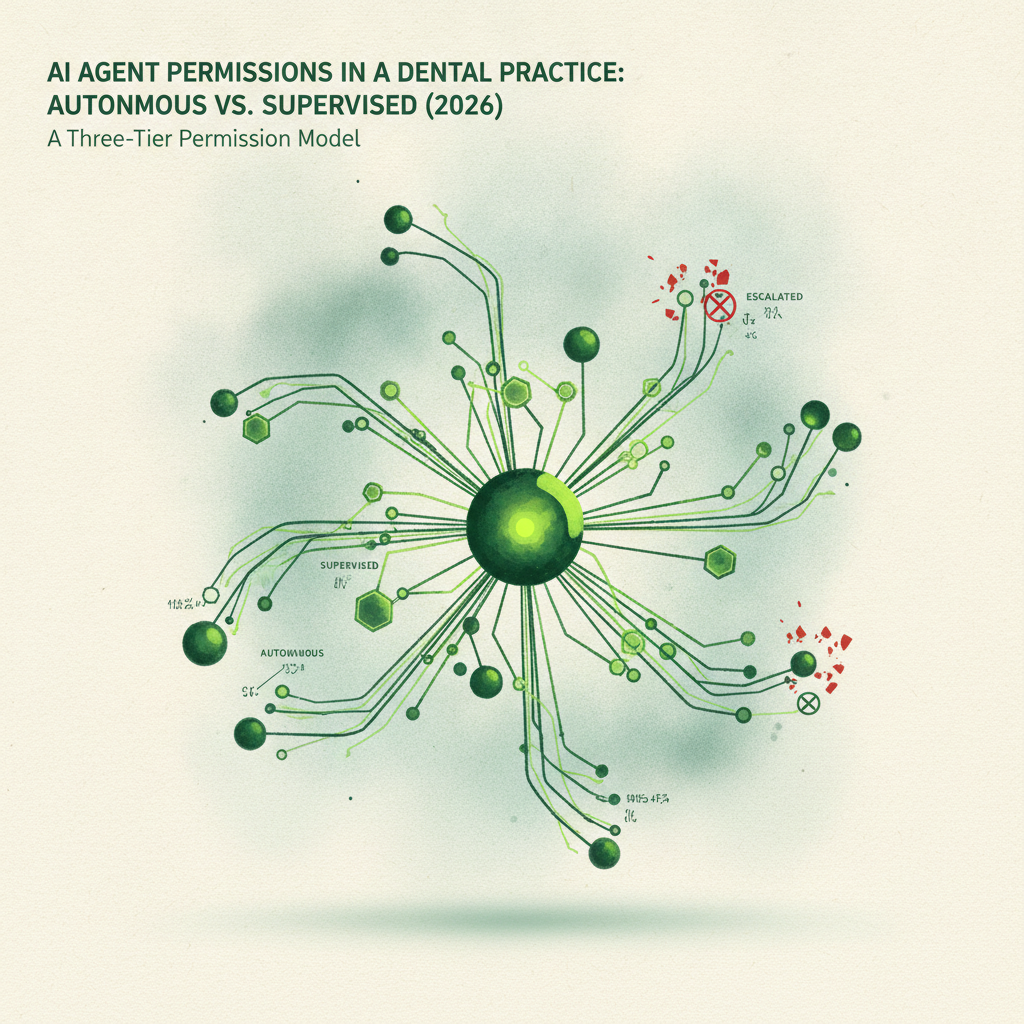
The question underneath most hesitation about AI running parts of a dental practice isn't "is the AI good enough" — it's "what happens if it's wrong, and who finds out before it matters." A well-designed permission system answers that question explicitly, for every single action an agent can take, by assigning it to one of three tiers: Autonomous (runs and logs), Supervised (drafts and waits for a human tap), or Escalated (restricted to an owner or manager, with a logged reason). This isn't a vague promise of "human oversight" — it's a specific, auditable, and adjustable governance layer. This is how that model actually works.
Key takeaways
- A permission system that isn't specific per action isn't really a permission system.
- Autonomous actions should be high-frequency, low-risk, and easily reversible or already deterministically validated.
- Supervised actions require a specific human approval of a concrete decision — not rubber-stamping a vague summary.
- Escalated actions are restricted to specific roles and always logged with a reason.
- Three categories should sit permanently outside any tier: signing a clinical record, writing a prescription, and making a diagnosis.
- A practice should be able to see and adjust tier assignments themselves, starting conservative and loosening over time.
Contents
- Why "human in the loop" isn't specific enough
- The three tiers, defined precisely
- What belongs in Autonomous
- What belongs in Supervised
- What belongs in Escalated
- The permanent exceptions
- Why tiers should be visible and adjustable
- How trust should actually build over time
- Questions to ask any vendor
- How Omnira implements permission tiers
- Frequently asked questions
- The bottom line
Why "human in the loop" isn't specific enough
Almost every AI vendor in healthcare says some version of "there's always a human in the loop." As a general reassurance, it's nearly meaningless — it doesn't say which loop, where the human sits, or what they're actually reviewing. A human shown a vague daily summary is providing fundamentally different oversight than a human asked to approve a specific decision before it takes effect, and both get described the same way in marketing.
A real permission system replaces that vague phrase with a specific answer for every category of action: exactly what tier does this fall in, and what does that tier require.
The three tiers, defined precisely
Autonomous — the agent performs the action and logs it, no human step required. Reserved for actions that are high-frequency, low-risk, and ideally already backed by deterministic validation, described in AI reads, code writes, so the "AI decision" is a rule-table lookup rather than a judgment call.
Supervised — the agent prepares the action and a human must actively approve it before it takes effect. The review should be of something concrete — an actual draft, an actual proposed change.
Escalated — restricted to a specific role, with the reason logged alongside it. Reserved for actions with consequences beyond the immediate task.
What belongs in Autonomous
Sending an appointment reminder. Running an eligibility check. Posting a clean electronic remittance matching expected values. Filling a cancelled slot from a ranked waitlist. Sending a recall touch on a defined cadence. Reviewing every one of these would be exhausting, pointless overhead that defeats the purpose of automation.
What belongs in Supervised
Submitting an insurance appeal. Posting a response to a public review. Launching a reactivation campaign to a large batch of patients. Activating a rule the system has learned. Presenting a treatment estimate to a patient. These are consequential or public-facing enough that a specific human decision on the specific instance is worth the few seconds it costs.
What belongs in Escalated
Overriding a required prior-authorization gate. Changing accounting mappings. Enabling a new third-party integration that will receive patient data. Approving a write-off above a defined threshold. If something goes wrong here, there's a specific, named decision to review.
The permanent exceptions
Three categories should sit permanently outside the tier system entirely:
Signing a clinical record. The treating clinician signs. An agent can draft and structure a note, but signing belongs to the person who provided the care.
Writing a prescription. Prescriber-only, executed through a certified e-prescribing system with its own identity verification.
Making a diagnosis. Clinical judgment stays with the clinician. AI-assisted findings are advisory input a clinician accepts under their own name.
Why these are permanent rather than temporary: clinical and prescribing authority are accountability structures, not just accuracy problems — the person whose name is on a note, a prescription, or a diagnosis should be the person who actually made that decision.
Why tiers should be visible and adjustable
A permission system a practice can't see or change isn't really governance. A real system lets a practice inspect exactly which tier a given action falls in and adjust it within reasonable bounds — starting more conservative than the vendor's default, and loosening specific tiers as trust in the specific system's behavior builds through direct experience.
This visibility also matters for audit: being able to say "this was Autonomous, here's the rule, here's the log" or "this was Supervised, here's who approved it" is a fundamentally better position than "the AI did something and we're not sure how it decided."
How trust should actually build over time
The healthy pattern: start with more actions in Supervised than the vendor might default to, watch drafts closely for the first several weeks, and loosen specific tiers to Autonomous only for action types proven reliable through direct, observed experience. A team that watches a system perform correctly, repeatedly, before loosening its leash tends to trust the eventual autonomy far more than a team simply told to trust it from day one.
Questions to ask any vendor
Show me the tier for a specific action, and why. Can I change tier assignments myself? What's logged when a Supervised action is approved? What are the three things this system will never let an agent do, regardless of tier? Can you show me an audit log for one specific action, start to finish?
How Omnira implements permission tiers
Omnira Dental is an AI-native operating system for dental practices — a single platform where six specialized AI agents run the practice's daily operations under human control: Luna (the orchestrator you talk to), Stella (scheduling and recall), Vera (billing and revenue cycle), Relay (patient communications and voice), Aria (clinical support), and Otto (operations, inventory, and analytics). Instead of bolting AI features onto legacy software, Omnira replaces the practice-management system itself, so the receptionist, the biller, and the chart share one brain and one ledger.
Every action any agent can take carries an explicit tier, visible in settings and adjustable per practice: eligibility checks and clean remittance posting run Autonomous; appeal submissions and learned-rule activation run Supervised; prior-authorization overrides and accounting changes run Escalated with a logged reason. Signing clinical records, writing prescriptions, and making diagnoses sit permanently outside the tier system for any agent, at any level of trust.
Frequently asked questions
What does Autonomous, Supervised, Escalated mean for AI agent permissions? A three-tier system: Autonomous means the agent acts and logs it with no human step first, Supervised means a human must approve before it takes effect, and Escalated means the action is restricted to a specific role with a logged reason.
What kinds of dental practice actions should be fully autonomous for AI? High-frequency, low-risk, easily corrected actions like appointment reminders, eligibility checks, and posting clean electronic remittances.
What dental practice actions should always require human approval? Consequential, public-facing, or precedent-setting actions: submitting insurance appeals, posting public review responses, and activating newly learned automation rules.
What should never be delegated to an AI agent in a dental practice? Signing a clinical record, writing a prescription, and making a diagnosis — permanent structural boundaries based on accountability, not temporary limitations.
Can a dental practice adjust which AI actions are autonomous versus supervised? In a well-built system, yes — tier assignments should be visible and adjustable, letting a practice loosen tiers as trust builds through direct experience.
How is human in the loop different from a real AI permission system? Human in the loop is often a vague claim. A real permission system assigns an explicit tier to every action category and defines exactly what human review looks like.
The bottom line
"There's always a human in the loop" is the least useful sentence in AI vendor marketing, because it says nothing about which loop, where the human sits, or what they're actually reviewing. A real governance layer replaces that vagueness with a specific, inspectable answer for every action, and it holds three categories permanently outside the system — not because current AI can't do them well enough, but because signing, prescribing, and diagnosing belong to a person, always.
Want to see the actual tier assignments and audit trail behind a specific action? Ask us directly — we'll walk through exactly what's autonomous, what's supervised, and what's permanently off the table.